
Tyre Sidewall Damage: Inspect Safely, Replace Fast with Local Fitting
Sidewall damage almost always means the tyre needs replacing, not repairing. Once cuts, bulges, or cracks reach the sidewall, the Tire Industry Association’s repair standards rule out a fix outright. The only exceptions are short, low-speed moves to safety, or a run-flat tyre buying you limited extra distance. Beyond that, get it swapped before you drive again.
TL;DR:
- Visible cords, bulges, or deep cuts in the sidewall require immediate replacement; repairs are only allowed if the damage is superficial and limited to the tread.
- Damage such as bulges and cracks indicate internal structural failure, making repairs unreliable and increasing the risk of sudden blowouts.
- Regular inspections should include checking for bulges, cuts, exposed cords, and deterioration, especially after hitting potholes or kerbs, with the tyre cold for accuracy.
- Repair rules restrict sidewall fixes because the rubber flexes constantly, and repairs in that area cannot withstand the stresses placed on the tyre.
- Prevention involves maintaining proper pressure, avoiding kerbing and overload, and inspecting tyres frequently to catch damage early before it worsens.
Table of Contents
- Types of tyre sidewall damage and what they actually mean
- How to inspect a sidewall without putting yourself at risk
- Why sidewall repairs are almost always against industry rules
- What to do right now if you find sidewall damage
- Preventing sidewall damage before it starts
- A publisher’s take on when to stop debating and just replace
- Get a replacement tyre sorted without the runaround
- Sources
- FAQ
Types of tyre sidewall damage and what they actually mean
Not every mark on a sidewall is a five-alarm problem, but the ones that look minor sometimes aren’t. Learning to tell the categories apart is the first step in any proper inspection.
- Scratches and nicks: Surface scuffs from a kerb or gravel are usually cosmetic if the rubber isn’t broken through. If you can see fabric or steel cord underneath, that’s no longer cosmetic.
- Cuts: A shallow cut through the top rubber layer might be harmless. A deep cut that reaches the cord body is a structural wound, not a blemish.
- Bulges or bubbles: A bulge means the internal cords have already torn or separated, letting air pressure push the liner outward. The AA’s guidance on tyre bulges is blunt about this: once cords fail, the sidewall can’t reliably hold pressure, and the tyre needs replacing.
- Cracks and weathering: Fine surface cracking from UV exposure and age is common on older tyres and worth monitoring. Deeper cracks that run into the sidewall structure, especially near the bead or shoulder, are a different story entirely.
- Punctures and deformation: A nail or screw straight through the sidewall is rare compared to tread punctures, but it’s also the most dangerous, because that area was never designed to be repaired.
How to inspect a sidewall without putting yourself at risk
A proper check takes five minutes and doesn’t require tools, but it does require knowing where your own judgement ends.
- Park on flat, stable ground and walk the full circumference of each tyre, not just the side facing you.
- Look for bulges first. Get down at wheel height and sight along the sidewall in low, raking light. A shadow that shouldn’t be there is often a bulge.
- Check for cuts and slices, running a finger lightly along any mark to feel depth (never press hard on a suspected weak spot).
- Look for exposed cord or fabric. Any colour other than black rubber, greyish threads, silvery steel wire, means the tyre is compromised.
- Check the inner sidewall where you can see it through the wheel spokes. Damage often shows there before it’s visible outside.
A fingernail test tells you whether rubber has been breached, but it can’t tell you what’s happening inside the carcass. That’s the limitation every owner needs to accept: internal cord separation doesn’t always show on the surface, which is why professionals demount the tyre for a proper look, exactly what the Tire Industry Association requires before any puncture repair goes ahead. If you spot a bulge, a deep cut, or exposed cord at any point, stop the visual inspection and arrange a tow or roadside assist rather than continuing to drive.
Pro Tip: Run your inspection after the tyre has cooled, not straight off a long drive. Heat can temporarily mask a small bulge that becomes obvious once the tyre settles.
Why sidewall repairs are almost always against industry rules
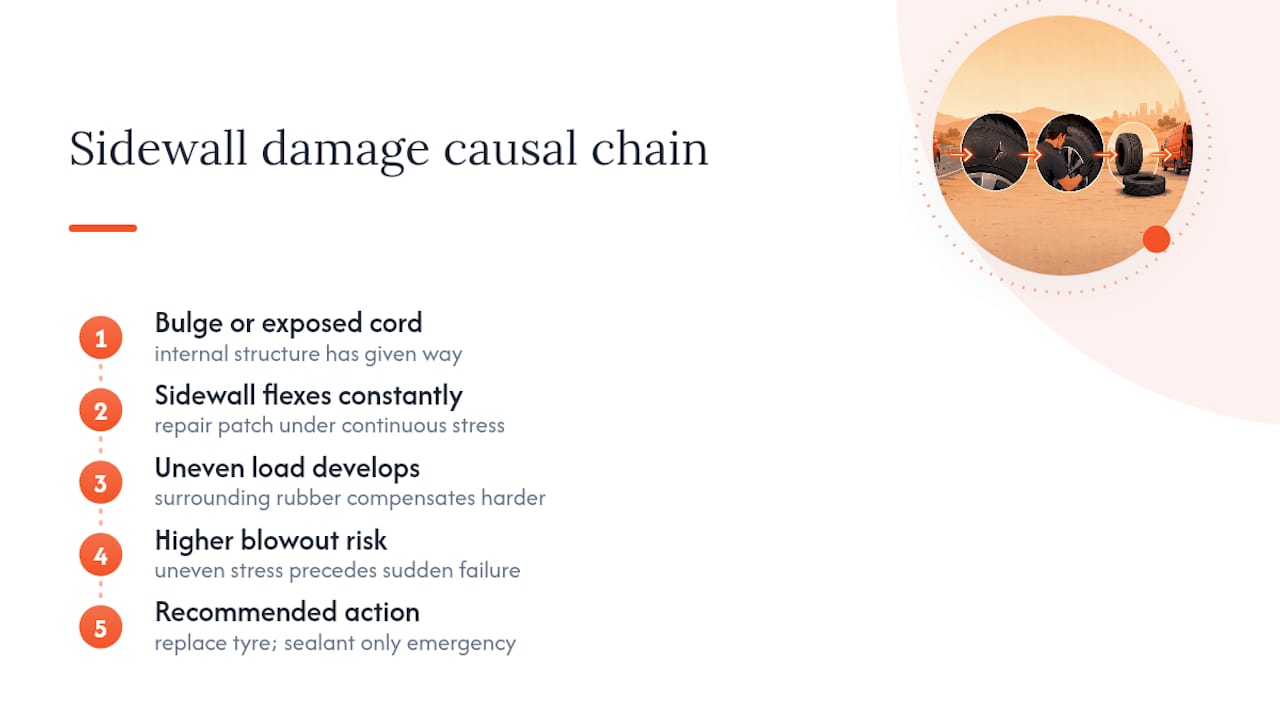
Puncture repairs are restricted to the centre of the tread for a specific engineering reason. Tread rubber is reinforced and relatively static under load; sidewall rubber flexes constantly with every rotation. A repair patch in that zone would be under continuous stress it isn’t built to handle, so the Tire Industry Association sets the rule plainly:
Puncture repairs must be performed only after demounting the tyre for full inspection, and any damage in the sidewall or shoulder area is considered non-repairable.
The same guidance caps repairable tread punctures at roughly 6.4mm (1/4 inch). Anything larger, and anything in the sidewall regardless of size, means replacement.
A bulge or exposed cord isn’t a cosmetic flaw waiting for a patch. It’s a sign the internal structure has already given way in one spot, and the surrounding rubber is now working harder to compensate. That uneven load is exactly what precedes a sudden blowout, and Pirelli’s own advisory on sidewall damage reaches the same conclusion: replace, don’t repair. Plug kits and aerosol sealants have a place, but only as an emergency measure to reach safety at low speed. Treating them as a permanent fix is how a manageable problem turns into a roadside emergency somewhere far less convenient.
What to do right now if you find sidewall damage
Once you’ve confirmed the damage, the decision tree is short.
- Bulge, deep cut, or exposed cord: Stop driving. Fit your spare if you have one and it’s roadworthy, or call for a tow. Don’t attempt to nurse the car home on a compromised sidewall.
- Slow leak with no visible bulge: You may have a few minutes of safe, low-speed driving to reach a safe pull-off point, but treat it as a countdown, not a commute.
- Run-flat tyres: These allow limited distance at reduced speed after damage, but Pirelli notes that replacement is still required as soon as possible, run-flat capability buys you time, not a repair.
When it’s time to replace, match the original tyre’s size, load index, and speed rating exactly, and check whether your car needs run-flats specifically rather than standard tyres. Pairing axles with matching tread patterns matters too, mismatched tyres on the same axle can affect handling in wet conditions. A tyre size calculator is the fastest way to confirm you’re buying the right fitment rather than guessing off the old sidewall markings. From there, an accredited fitter, a manufacturer dealer, or an online tyre marketplace with local fitting partners can get the swap done without you ringing around five different shops.
Preventing sidewall damage before it starts
Most sidewall damage traces back to a handful of preventable habits, and Pirelli’s advisory lists potholes, kerbing, overloading, and underinflation as the recurring culprits.
- Check pressure monthly against the manufacturer’s figure, not the tyre’s maximum rating, and let a TPMS alert prompt an immediate check rather than a “later” one.
- Give kerbs and potholes a wider berth than feels necessary, especially when parking or turning tightly.
- Don’t overload the vehicle. Extra weight flexes sidewalls further than they’re rated for, especially combined with low pressure.
- Read the DOT code on the sidewall to check manufacturing age; tyres beyond the manufacturer’s recommended service life warrant replacement even without visible damage, a point the AA also flags in its bulge guidance.
- Inspect tyres regularly, not just when something feels off, using a quick visual sweep every fortnight.
Pro Tip: When reversing into a parking spot, ease off the accelerator earlier than feels natural. Most kerb strikes happen in the last half-metre, not the approach.
A publisher’s take on when to stop debating and just replace
Sidewall damage isn’t a call-it debate. If cords are visible or there’s a bulge, replace the tyre. Some online tyre marketplaces with verified fitters and AR visualisation exist to make that replacement fast, not to talk you out of caution.
— Areesh
Get a replacement tyre sorted without the runaround
Once you’ve decided a damaged sidewall means replacement, the slow part is usually everything after that decision, ringing shops, comparing quotes, hoping the fitter has your size in stock. Some tyre marketplaces allow you to search by your vehicle model or tyre size, view transparent pricing without hidden fees, and complete checkout quickly, sometimes with same-day fitting confirmation from local partners.

This is the option worth using when you need a tyre replaced today, not next week: no phoning around, no guessing whether the quoted price is the final price. Head to Treadivo’s tyre search to match your exact fitment and lock in a fitting slot near you.
Sources
- Tire Repair - Tire Industry Association
- How do you spot the first signs of tyre bulge? | The AA
- Tyre wall damage: can it be repaired? | Pirelli
FAQ
Is it safe to drive on a tyre with sidewall damage?
Generally no. Cords, bulges, or deep cuts in the sidewall signal structural weakness that can fail suddenly under load, so the safest move is stopping and arranging a tow or spare swap rather than continuing on.
How much sidewall damage is acceptable before replacing?
Very little. Industry repair rules cap repairable tread punctures at around 6.4mm, but sidewall damage of any size in that zone is treated as non-repairable.
Can sidewall tyre damage be fixed?
Almost never permanently. Repairs are restricted to the tread’s centre area because sidewall rubber flexes constantly and can’t hold a patch reliably, which is why the Tire Industry Association rules it out.
What should I do if my tyre’s sidewall is damaged?
Stop driving as soon as it’s safe, fit a roadworthy spare if you have one, and call roadside assistance if you see a bulge or exposed cord. Once you’re safe, arrange a replacement through an accredited fitter or a service like Treadivo’s tyre search that confirms same-day fitting.